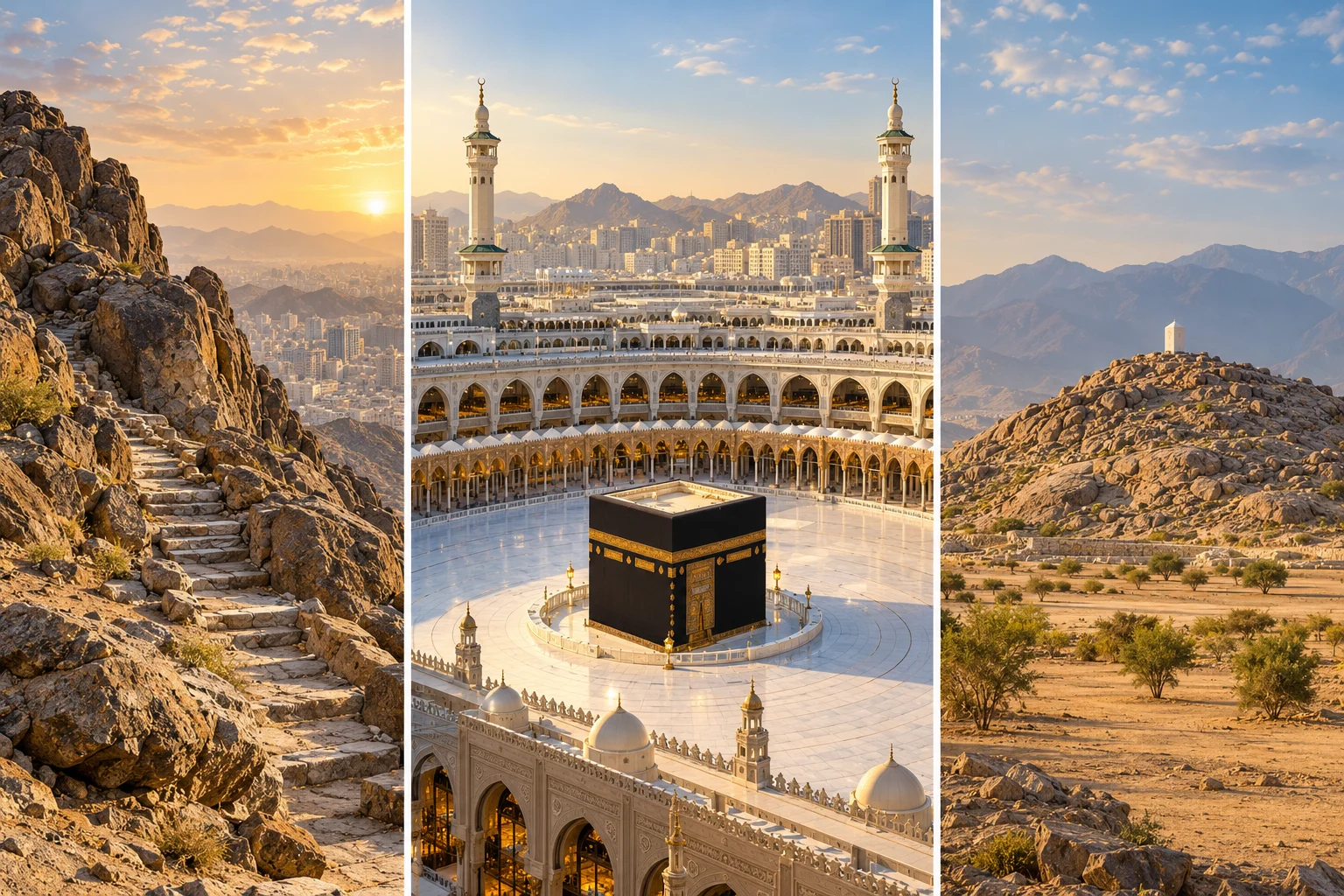
This Makkah Ziyarat guide explains twelve places and visiting areas you may want to understand during your stay: the Grand Mosque, historic mosques, mountain landscapes and the Hajj sites around the city. Each entry separates the place's background from the practical decisions involved in visiting it.
Start with the visits that matter to your family, then build an itinerary around your hotel, available time and walking needs. A short road outing, an exhibition visit and a mountain ascent involve very different commitments. Keep worship, meals and rest in your schedule rather than trying to complete every place on a list.
What does Makkah Ziyarat include?
In travel planning, Ziyarat commonly refers to visits made to learn about Islamic history and significant places. This article includes Masjid al-Haram for orientation, alongside optional historical excursions. These are different activities: a sightseeing circuit does not replace the rites of Umrah. Use the Ministry of Hajj and Umrah's pilgrim guide and qualified guidance for questions about worship.
Some landmarks are close to central Makkah; others belong to the wider Mina–Muzdalifah–Arafat area or require a separate journey. The twelve entries below are choices for planning, not a promise that every location is accessible or included in one taxi booking.
Makkah Ziyarat places at a glance
| Place or visiting area | Main interest | What to decide before travel |
|---|---|---|
| Masjid al-Haram | Kaaba, worship and orientation within the Grand Mosque | Hotel approach, meeting point and walking needs |
| Jabal al-Nour and Cave of Hira | The mountain and cave associated with the first revelation | A view from below or a separately planned ascent |
| Hira Cultural District | Exhibitions and interpretation at the mountain's foot | Which exhibition you want to visit and its current arrangements |
| Jabal Thawr | Historical context of the Hijrah | Roadside viewing or a dedicated mountain outing |
| Masjid Aisha at Taneem | A mosque associated with Aisha's Umrah journey | Purpose of the visit, waiting and return collection |
| Jannat al-Mualla | Makkah's historic cemetery | Current permitted access and respectful conduct |
| Masjid al-Jinn | A historic mosque connected with Quranic recitation | A suitable visiting time and reachable collection point |
| Mina | The valley and tent-city landscape associated with Hajj | Current road access and the scope of the visit |
| Masjid al-Khayf | A mosque within Mina with Hajj significance | Whether an exterior stop is possible; do not assume interior access |
| Muzdalifah | The holy-site landscape between Arafat and Mina | An agreed road stop if access permits |
| Arafat and Jabal al-Rahmah | The Arafat plain and its well-known rocky hill | Ground-level visiting, walking and return arrangements |
| Masjid Namirah | A landmark associated with the Day of Arafah | Treat it as an exterior-view request unless access is confirmed |
1. Masjid al-Haram: begin with the heart of your stay
Masjid al-Haram, the Grand Mosque, houses the Kaaba and is central to pilgrims' time in Makkah. Understanding its setting helps you organise your hotel stay, worship and movement before adding trips elsewhere. Saudipedia's Grand Mosque overview provides historical and architectural background.
For practical orientation, read our inside Masjid al-Haram guide, which introduces the Kaaba, Mataf and Safa and Marwa area. Agree a meeting point with your family and keep your accommodation details accessible. If arranging a vehicle, give the hotel entrance pin and follow the reachable collection location confirmed for that journey. A mosque gate number alone does not establish a taxi pickup point.
2. Jabal al-Nour and the Cave of Hira: one mountain destination
Jabal al-Nour, also written Jabal al-Noor, contains the Cave of Hira, associated with the first revelation to Prophet Muhammad, peace be upon him. The mountain and cave are connected parts of the same destination; listing both does not mean two easy stops. The historical association is described in Saudipedia's Makkah historical-sites overview.
Specify whether you want to see the mountain from a road-accessible location, visit the district below it or consider an ascent. The climb needs its own allowance for the outward walk, time near the cave, descent and regrouping. Do not fit it into a short taxi pause by assumption. Discuss the group's walking ability and current visiting arrangements before committing the whole family to the same activity.
3. Hira Cultural District: learning at the foot of the mountain
Hira Cultural District is a distinct visiting experience at the foot of Jabal al-Nour. Its cultural facilities include the Revelation Exhibition, offering an interpretation of the history of revelation. It gives visitors another way to engage with the subject without making a summit climb the centre of the outing. See the official Hira Cultural District visitor information.
Choose the exhibition or experience you want before asking for transport. Check its current opening, booking and admission arrangements, then allow time to enter and explore. Leave the exact duration flexible enough for your group. Tell the transport team whether you need the vehicle retained or a later collection; a drop-off at the district does not include exhibition admission or a trip to the cave.
4. Jabal Thawr: understand the Hijrah setting
Jabal Thawr is associated with the refuge taken by Prophet Muhammad, peace be upon him, and Abu Bakr during their migration towards Madinah. It is a separate mountain from Jabal al-Nour, with a different historical context. Saudipedia's historical-sites account explains that association.
A request to see the mountain's surroundings should not be interpreted as a cave ascent. For a road-based itinerary, ask where a permitted stop can be made and what is visible from there. If considering a climb, organise it as a dedicated activity and explain who will participate. Agree what happens to relatives who remain below, where everyone will meet afterwards and how waiting will be charged. Avoid promising an exact ascent time for people with different abilities.
5. Masjid Aisha at Taneem: plan the purpose and return
Masjid Aisha is also called Masjid at-Taneem or At-Tan'im. Its historical association is with Aisha, may Allah be pleased with her, assuming Ihram for Umrah. The official At-Tan'im Mosque page explains the mosque's background.
Tell the team whether your request is a mosque visit or transport connected with an intended Umrah. Do not assume a Taneem journey settles the Miqat preparation for every traveller arriving from outside Makkah. Clarify your circumstances through the Miqat guide and suitable qualified advice before travel.
Use the Masjid Aisha return-transfer page to specify your hotel, preferred collection, expected waiting and final drop-off. A one-way fare and a vehicle waiting for your return are different arrangements.
6. Jannat al-Mualla: a respectful historical visit
Jannat al-Mualla, also known as Al-Ma'alah Cemetery, is one of Makkah's oldest cemeteries. Historical accounts associate it with prominent early Muslim figures, including Khadijah bint Khuwaylid, may Allah be pleased with her. Saudipedia's cemetery article provides further context.
Treat a visit here differently from a scenic photo stop. Follow the current instructions at the location, respect funerals and other visitors, and avoid obstructing entrances. A cemetery's historical significance does not establish that an individual grave can be identified for visitors. Confirm the permitted visiting scope for your party before including an interior visit in the schedule. Ask about the reachable pickup and any walking involved rather than assuming the vehicle can stop wherever the group chooses.
7. Masjid al-Jinn: a historic mosque in the city
Masjid al-Jinn is connected with the account of a group of jinn listening to the Prophet's recitation of the Quran. It is among the historic mosques discussed by the official Discover Makkah visitor portal.
Allow time for a respectful mosque visit rather than treating the building as a quick roadside landmark. When coordinating nearby city stops, identify the actual entrances and where the group can be collected. A mosque visit and a cemetery visit have different access and conduct considerations even if both appear in the same proposed itinerary. If you want historical narration, request a guide separately; transport to the mosque does not automatically include a guided explanation.
8. Mina: understand the Hajj landscape
Mina is one of the principal holy sites associated with Hajj and is known for its extensive tent accommodation. Seeing the wider area can help visitors understand the setting of the pilgrimage beyond central Makkah. Read Saudipedia's Mina overview for background on the site.
For a visiting itinerary, describe the area you hope to see rather than simply request access to “the tents.” Road permissions, seasonal operations and the reachable route need checking for your date. A taxi outing does not grant entry to camps or operational facilities. A road-based visit to Mina should also be distinguished from participating in Hajj; do not add ritual activities to a general sightseeing plan without understanding their proper context.
9. Masjid al-Khayf: a separate question of access within Mina
Masjid al-Khayf is a significant mosque in Mina, associated with the Prophet's Hajj. Its inclusion on a Ziyarat list should not be taken as evidence that it is open for an ordinary interior visit throughout the year. Saudipedia's mosque entry describes its Hajj-season use.
Ask whether a permitted exterior view is possible on your actual journey. If interior access is important, obtain current confirmation instead of building the day around an assumed opening. Keep that request explicit when agreeing stops and waiting. Mina and Masjid al-Khayf have different explanatory roles in this guide, but they belong to the same broader visiting area; they should not be priced or scheduled as unrelated distant trips.
10. Muzdalifah: connect the geography of the holy sites
Muzdalifah lies between Arafat and Mina and is associated with the pilgrims' Hajj journey after Arafat. Al-Mash'ar al-Haram Mosque is among the landmarks discussed in Saudipedia's Muzdalifah overview.
The value of a visit is understanding the landscape and its relationship to the other holy sites. For a road outing, ask what can be reached and where any permitted stop would be made. Do not assume that a mosque visit, an extended walk and a short view from the vehicle have the same duration or fare. Keep Muzdalifah within the agreed route and avoid promising that a particular area will be available for stopping during seasonal operations.
11. Arafat and Jabal al-Rahmah: the plain and the hill
Arafat is a major Hajj site, while Jabal al-Rahmah is the well-known rocky hill within that wider landscape. They are not interchangeable names for the entire visiting area. The Arafat site overview explains its place among the holy sites.
Decide whether your group wants a ground-level visit, a short walk or a longer stop. Do not assume everyone must climb the hill to understand the location. Include shade, rest and the return to the collection point in your practical plan. If combining Arafat with Mina and Muzdalifah, ask the team to confirm the driving order for your starting hotel and the access available that day. A fixed sequence copied from another traveller's trip may not suit your endpoints.
12. Masjid Namirah: a landmark to view with realistic expectations
Masjid Namirah, also written Namira or Nimrah, is associated with the Day of Arafah and the Hajj sermon. It stands along the western boundary of Arafat. The official Namira Mosque visitor information describes its setting and identifies exterior viewing as the ordinary visiting expectation rather than unrestricted entry.
Request a permitted view from the route and ask whether a stop can actually be made. Do not promise your family an interior visit because the building appears in photographs of Hajj. If another stop or appointment depends on timing here, discuss an alternative in advance. Namirah can be understood as part of the Arafat visiting context without turning the trip into a guarantee of access to every mosque on the list.
How to build a Makkah Ziyarat itinerary
Use the following as planning examples, not fixed tours. None assumes that every listed site is open or that a driver can follow the same road arrangement on every date.
A gentle city-and-exhibition outing: begin from your hotel, choose a permitted city mosque or historical stop, then allow a separate visiting block for Hira Cultural District. Return for rest rather than adding a mountain ascent automatically. This approach lets you discuss shorter walks and boarding needs before selecting a vehicle.
A holy-sites road itinerary: request Mina, Muzdalifah and Arafat, with exterior mosque views only where confirmed. Tell the team whether you want time outside the car at each stop. Ask for the driving order and realistic travel allowance from your own accommodation; keep Namirah and al-Khayf access conditional.
A dedicated mountain visit: choose one mountain activity, describe the participants and agree the meeting and return. Keep an exhibition or extra city stops optional. A cave ascent should not be squeezed into the remaining time of a short vehicle booking.
A Taneem return journey: if Masjid Aisha is the specific purpose, book that scope clearly. Confirm waiting and the return destination instead of assuming the vehicle will remain throughout a general Ziyarat tour.
Families, older pilgrims and visitors with mobility needs
Choose the itinerary around the people travelling. Ask which stops can be enjoyed with a shorter walk, who can manage vehicle steps and whether the group should split activities. When someone uses a wheelchair, explain whether it folds, whether the passenger can transfer to a regular seat and what boarding arrangement is needed. Storage for a chair is different from ramp access.
Take suitable footwear and plan access to drinking water and rest. Consider how conditions will affect the group on the chosen day rather than advertise one universal “best” visiting hour. For personal health questions about exertion or heat, seek advice appropriate to the traveller before selecting a climb. Our senior pilgrim guide and wheelchair assistance guide help organise the practical questions.
Booking Makkah Ziyarat transport and comparing a quote
Use the Makkah Ziyarat taxi service for the actual vehicle enquiry. Send your hotel entrance, local date, preferred start, passengers and chosen stops. List children, bags, equipment and assistance needs. State whether the vehicle waits, returns later or finishes at another destination.
Ask for a total in SAR covering the agreed vehicle, stops and waiting. Clarify extra waiting, changes and return collection before confirming. Read the Ziyarat duration and cost guide and fleet comparison, then send your journey. This article does not establish a current fare, an admission ticket, a guide or a confirmed vehicle reservation.
If your stay continues in Madinah, build a separate city itinerary using the Madinah Ziyarat guide. Arrange the Makkah-to-Madinah transfer as its own journey; combining the two cities' place names in a reading list does not make them one local outing.
Frequently asked questions
Which are the main Ziyarat places in Makkah?
Common visiting interests include Jabal al-Nour and Hira, Jabal Thawr, Masjid Aisha, Jannat al-Mualla, Masjid al-Jinn and the wider Mina, Muzdalifah and Arafat areas. Select the places that suit your time and mobility, and confirm current access before arranging transport.
Is Ziyarat required to complete Umrah?
The optional historical excursions in this guide are separate from the rites of Umrah. A sightseeing circuit or mountain ascent does not replace those rites. Use qualified religious guidance for questions about your own circumstances.
Can I visit all twelve places in one day?
Do not plan on that without checking the scope. A mountain ascent, an exhibition, worship at the Haram and road visits to the holy sites need different amounts of time. Choose priorities and ask for a realistic itinerary, with access and waiting confirmed for each requested stop.
Is a Hira Cultural District visit the same as climbing to the cave?
No. The district at the mountain's foot offers cultural facilities, while the Cave of Hira involves a separate ascent. Specify which experience you want and arrange transport, entry and time accordingly.
Can a Makkah Ziyarat taxi enter every mosque and holy site?
No. Vehicle access and visitor entry are separate matters. Confirm the current permitted route and stopping points. Do not assume interior access to al-Khayf or Namirah, entry to camps, or collection at a particular Haram gate.
What should I send when requesting a Ziyarat taxi?
Send the hotel entrance pin, date, start time, passengers, luggage, selected stops and return destination. Include waiting, walking or boarding requirements, and explain whether any mountain activity or admission-based visit is intended.
Is Masjid Aisha automatically included in every tour?
No. Request it explicitly and agree whether you need a short visit, waiting or a separate return transfer. Clarify religious preparation separately rather than assume one Taneem trip applies to every arriving pilgrim.
Can we combine Makkah and Madinah Ziyarat in the same local outing?
Plan each city separately and allow for the intercity journey. Request dates, hotels and transport for every leg instead of treating both cities as one local taxi circuit.